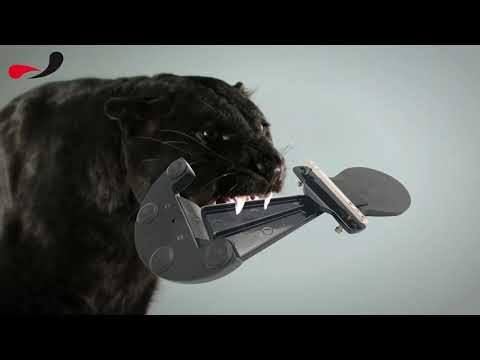
Strike
The heel becomes an active striking point.
The Tool for the Masters.Introducing the most advanced bass drum pedal technique.
PATENTED VRUK TECHNOLOGY · 1989
SLIDING HEEL · ORIGINATED 1974

650 STROKES · SINGLE KICKTIM WATERSON · NAMM 2003
“TOTALLY NEW”MODERN DRUMMER · 1990
“MOELLER ON FOOT”JIM CHAPIN
COZY POWELLEARLY ENDORSER
“THIS PRODUCT EXCEEDS
MY EXPECTATIONS”CHRIS ADLER
01 · THE TECHNOLOGY
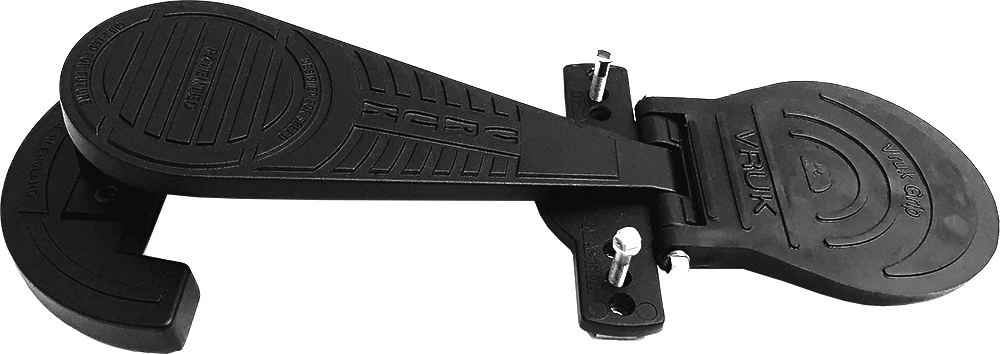
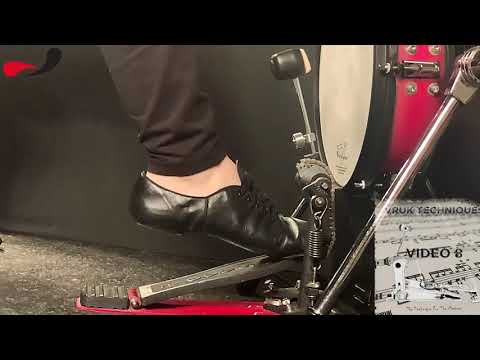
VRUK is an auxiliary sprung heelboard attached to the conventional bass drum footboard. The heel can strike, rest and release—without choking the beater rebound.
THE MAJOR BREAKTHROUGH
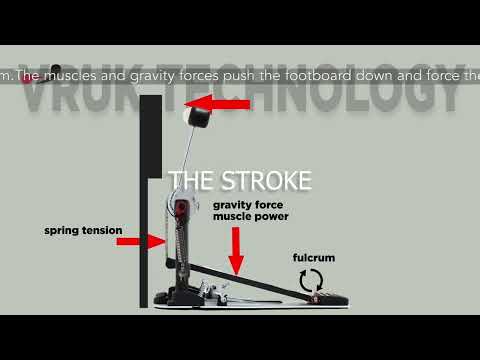
The heel lands on a soft, responsive platform. Its energy travels through the link to the pedal, while the heel’s weight leaves the footboard free for immediate beater rebound.
The heel becomes an active striking point.
No residual weight chokes the footboard.
Connection remains through the complete cycle.
TECHNOLOGY TRAILER
An introduction to the VRUK heelboard, the new striking point it creates and the movement it makes possible.
 ▶
▶How the VRUK grip supports control between the heel, the heelboard and the pedal.
Watch the film ↗ ▶
▶See how the VRUK system is designed to work as a universal tool across conventional drum pedals.
Watch the film ↗ ▶
▶A direct demonstration of the relationship between the foot, the VRUK heelboard and the beater.
Watch the film ↗DETAILED EXAMINATION
Six focused films examine the VRUK mechanism and its operation in greater detail.
 ▶
▶ ▶
▶ ▶
▶ ▶
▶ ▶
▶ ▶
▶02 · ROTATION TECHNIQUE
Traditional techniques strike from the toes. VRUK Rotation Technique adds the heels, opening four controlled striking points across two pedals.
EIGHT CORE RUDIMENTS
RH · RT · LH · LT
↗RT · RH · LT · LH
↗RH · LH · RT · LT
↗LH · RH · LT · RT
↗RH · LT · LH · RT
↗LH · RT · RH · LT
↗RH · LH · LT · RT
↗LH · RH · RT · LT
↗THE PRINCIPLE
A stroke is defined not only by the beater’s impact, but by the time on either side of it. Conventional heel-toe motion often rushes heel-to-toe and slows toe-to-heel, producing flam-like groups. Rotation Technique makes both intervals equal—TBS = TAS—creating evenly spaced single strokes from heel to toe to heel.
ROTATION TECHNIQUE · SINCE 1993
Introduced through its rudiments in 1993, Rotation Technique is the basic motion designed specifically to develop maximum ankle flexibility and ingrain the correct directions of movement. Every stroke must be played with a full rotation. Once the ankle is flexible and the motion is established, begin incorporating the natural bounce of the beater. Speed will then develop naturally as rotation and rebound work together.
Download the interactive book ↓The established methods, their strengths, and the limitation VRUK was designed to solve.
 ▶
▶ ▶
▶ ▶
▶ ▶
▶ ▶
▶ ▶
▶ ▶
▶ ▶
▶ ▶
▶ ▶
▶04 · HERITAGE
From an accidental heel strike to an entirely new system for bass drum technique.
MR VRUK discovers Sliding Heel—Klizeca Peta—while searching for a usable heel stroke.
After three years of development, the final concept for a dedicated secondary heelboard is completed.
The first prototype is built in England; the first production examples follow, including a pair for Cozy Powell.
VRUK is demonstrated on the DW stand. Jim Chapin describes the idea as ‘Moeller on foot’.
Modern Drummer introduces VRUK as a completely new product—not a shortcut, but a technique to be learned.
Rhythm calls the system a ‘stroke of genius’; Modern Drummer recognises it in its Gear of the Year coverage.
A limited chrome edition and a national teaching tour introduce the system to more than 10,000 drummers.
The book brings the technology, science, exercises and complete linked video course together.
“IN A WORLD OF CONFORMITY, WE NEED MORE MAVERICKS LIKE MR VRUK.”
RHYTHM MAGAZINE · 2003
05 · SUPPORT
Begin with the support introduction, then continue through five practical video guides to installation, adjustment and everyday use.